
Natural Rights & Democracy
Natural Rights
The concept of natural rights is plain and simple. It is that every human being of majority age is free to do or have whatever he or she wants as long as it does not infringe upon another’s equal rights. A person may voluntarily give up some rights, usually in the form of service or money, to join in an association or compact with neighbors for protection and other benefits. These other benefits might include putting in roads and utilities, educating their children, and constructing and maintaining public buildings.
A just government has no rights except what the people voluntarily give it. It cannot legislate, declare or confer rights. The Founders of the United States, in their wisdom, ascribed to its government and enumerated in its constitution, only limited powers. They further codified a Bill of Rights to prevent the government from usurping the people’s natural rights. Here is its First Amendment as an example:
Congress shall make no law respecting an establishment of religion, or preventing the free exercise thereof; or abridging the freedom of speech, or of the press; or the right of the people peaceably to assemble, and to petition the government for a redress of grievances.
Any government that acts beyond the powers delegated to it by the people is tyrannical and should be revised or changed.
Democracy & Home Rule
Home rule and the Rule of Law in the modern era, fostering freedom and justice, began in earnest in Southern New England under an early constitution titled, the Fundamental Orders of 1639, conceived in response to a sermon by Thomas Hooker, in which he said: The foundation of authority is laid firstly in the free consent of people. It was a radical idea for its time.
The Orders reflected the desires of a commission of magistrates and representatives, appointed from the three river towns of Wethersfield, Windsor, and Hartford, to secure their safety from hostile Indians and to foster stable relations among themselves.
This experiment in republican government, whereby towns sent representatives to the Colony Court at Hartford for discussion, debate, and action, proved remarkably effective, and was copied by other colonies. For the balance of the seventeenth century and throughout the eighteenth, most towns were small enough so that town meetings could function democratically.
So, What Happened?
As towns and cities grew, finding space large enough for heads of households to meet became impractical and large assemblies discouraged careful deliberation of important matters. Representatives were therefore elected by the people and sent to town or city councils. If they were elected by district, there was some protection to local neighborhoods. When each councilman was chosen by all voters in a town, even that protection was lost. Authority for decision making, formerly resting with each person and each neighborhood or district, gravitated to the central government.
Can Self-Rule and Liberty be Regained?
The answer is, of course: There should be democracy. All adults should have a voice in every decision affecting them or elect like-minded delegates to stand for them. The object of good government is to secure the lives, property and dignity of all men and women.
How Can it be Regained?
One answer to having self-rule is to have plebiscites like the Swiss have. Plebiscites, however, if not carefully restrained with checks and balances, may foster majority tyranny and hamper progress. To temper the mob-like behavior of unchecked democracies and to prevent governments from meddling in the affairs of their constituents, a federated system of government (also like the Swiss have and the United States of America had before the Civil War) and a strong constitution are needed.
What is Effective Federalism?
It is a form of government in which the people, in their councils and assemblies, make decisions democratically and elect trusted men and women to stand for them in higher places. It is a form of government having a strong constitution or charter protecting the natural rights of the people by ascribing limited powers to the government and requiring checks and balances to prevent one department from assuming undue powers to itself. It is a form of government that avoids meddling in the internal affairs of its constituents except as allowed by the constitution or charter.
The Founders of the United States wisely added a bill of rights to the Constitution adding further protections for its citizens and states by forbidding the government from venturing into areas where governments are wont to be abusive. The Tenth Amendment is shown here:
The powers not delegated to the United States by the Constitution, nor prohibited by it to the states, are reserved to the states respectively or to the people.
How to Protect Democracy in Councils and Assemblies
Democracy means the people rule. And insomuch as our founding documents declare that all men are created equal (equal before the law and of equal worth in the sight of God), every member of a council or assembly should be given equal opportunity to bring forth proposals and comment, discuss, and vote on common matters. This requires that meetings are conducted by a chairperson familiar with basic parliamentary procedures who can bring out the best ideas and creative energies of each member. The chairperson must not act like a director or manager, forcibly set agenda, or play favorites.
Large governmental United States should be subdivided, keeping meeting and assembly sizes small for effective discussion and action. In this way citizens have more senatorial representation and greater control over their lives, their families, property and affairs. Every opportunity should be given to let the people be free to work out their own problems, and free to keep their own money to fund the programs and activities they choose. Governments must not foist requirements upon them against their will. Rather, legislators and executives should lead by example and simplify and slash administrative burdens. Finally, executives, senators, representatives, and councilmen should learn the principles behind the Constitution and respect their oath of office, which is to honor, sustain and defend it.
Thomas Jefferson, summarized the approach governments must take to secure liberty and justice (Letter to Joseph C. Cabell, 2 February 1816):
… the way to have good and safe government, is not to trust it all to one; but to divide it among the many, distributing to every one exactly the functions he is competent to.
let the National government be entrusted with the defense of the nation, and it’s foreign & federal relations;
the State governments with the civil rights, laws, police & administration of what concerns the state generally;
the Counties with the local concerns of the counties; and
each Ward direct the interests within itself.
It is by dividing and subdividing these republics from the great National one down thro’ all it’s subordinations, until it ends in the administration of every man’s farm and affairs by himself; by placing under every one what his own eye may superintend, that all will be done for the best.
A Wise and Virtuous Senate
A legislature with two chambers, elected or appointed by different means, affords greater protection to the people than a single chamber by having different perspectives on how to address the problems of the day. The original Constitution for the United States held that the members of one chamber are elected by popular vote, while those of the other are elected by state legislatures.
In this modern age, when public opinion can be manipulated by specious media campaigns heavily funded by special interests, and with artificial intelligence bots multiplying their effectiveness, a properly functioning Senate is needed. Wise and virtuous Senators, appointed by lower United States legislators rather than the popular vote, could be the salvation of federalism and even Western society.
Because Senators are elected by their peers, familiar with their character and abilities, those selected would more likely be wiser and better qualified than if elected by a popular vote. In the words of Oliver Ellsworth, delegate from Connecticut at the Constitutional Convention, June 25, 1787:
Wisdom was one of the characteristics with which it was contemplated to give to the second branch. Would not more of it issue from the legislatures; than from an immediate election by the people? He urged the necessity of maintaining the existence and agency of the States. Without their cooperation, it would be impossible to support a republican Govt.
And from James Madison, delegate from Virginia, who spoke the next day:
In framing a system which we wish to last for ages, we shd. not lose sight of the changes which ages will produce. An increase of population will of necessity increase the proportion of those who will labour under all the hardships of life, & secretly sigh for a more equal distribution of its blessings. These may in time outnumber those who are placed above the feelings of indigence. According to the equal laws of suffrage, the power will slide into the hands of the former. … How is this danger to be guarded agst. on republican principles? How is the danger in all cases of interested coalitions to oppress the minority to be guarded agst.? Among other means by the establishment of a body in the Govt. sufficiently respectable for its wisdom & virtue, to aid on such emergencies, the preponderance of justice by throwing its weight into that scale. Such [are] the objects of the second branch in the proposed Govt.
Maintaining the existence and agency of the States was lost in the United States with passage of the Seventeenth Amendment. This amendment changed the election of Senators from election by State legislatures to a popular vote, contrary to Article V of the U. S. Constitution which declares that no state, without its consent, shall be deprived of its equal suffrage in the Senate. To have a properly functioning Senate, this Amendment must be rescinded.
Summary of Principles for a True Democratic Republic
1. Council and assembly sizes are small enough so that each member is acquainted with and knowledgeable of the character, disposition and relationships of the other members.
2. With good chairpersons or parliamentarians, each citizen has an equal voice in making motions, taking part in discussions and debates, and voting on matters of concern, including selecting delegates to higher governmental bodies.
3. Higher governmental United States must not meddle in the affairs of their constituents except as required by the Constitution.
4. A strong Constitution, asserting what the government can and cannot do, is held inviolate by the people.
5. Governments of towns, cities, counties, provinces, or nations, each has a Senate made up of wise and virtuous men and women, elected by lower United States legislatures (or just their Senates) to secure liberty and justice for the people and protection for their constituents.
A SENATE FOR THE PEOPLE
WHY IS THIS NEEDED TODAY?
UNLIKE AT THE FOUNDING OF THE UNITED STATES, WHEN MOST ACTS OF GOVERNING WERE DECIDED IN TOWN MEETINGS, WE ARE UNINVOLVED.
In today’s world most of us are removed from decisions made in the halls of government. We elect councilmen, representatives and senators to write the laws.
We elect mayors, governors and the president. who choose department heads and others to write policies, procedures, and manage the government’s programs.
How are Senators Presently Chosen?
Interested voters cast their votes for senators in political party primaries from among interested candidates, usually proposed by party leadership. The leading candidate from each party, plus any write-ins, are voted on at the general election in November.
Registered voters cast their votes for the candidate they believe will best represents them.
How are voters persuaded to believe that the candidate they vote for will properly represent them?
1. Interested stake holders: party leaders, unions, corporations, media giants, Universities, NGOs, and others, conduct or fund focus group research, opinion poles, and the distribution and collection of questionnaires to find out what the people want.
2. They hire public relations and advertising firms to craft messages to make their favored candidates appear to be what the people want, and then represent them well.
3. They spend lots of money to media outlets advertising the virtues of favored candidates to force public opinion.
Is There a Better Way?
At the founding of the United States, civil matters were decided at town meetings. Because most towns were small, all freemen could participate by making proposals, debating, and voting. And they were personally acquainted with the character and disposition of those they chose as delegates to the State legislative assembly.
The State legislative assembly totaled about 200. These legislators were also acquainted with the character and disposition of those they chose as Senators. This mode of electing Senators remained in effect until 1913.
The Better Way
1. Keep assembly sizes small.
2. Have impartial chairpersons in each assembly who understand parliamentary procedure and encourage each member to submit proposals, debate and vote.
3. Brainstorm for proposals; vote on and rank them.
4. Submit the best proposals with the chosen senator(s) to the next level of government.
5. Repeat the process at each level up to and including the national Senate.
A SENATE FOR THE PEOPLE
WHY IS THIS NEEDED TODAY?
UNLIKE AT THE FOUNDING OF THE UNITED STATES, WHEN MOST ACTS OF GOVERNING WERE DECIDED IN TOWN MEETINGS, WE ARE UNINVOLVED.
In today’s world most of us are removed from decisions made in the halls of government. We elect councilmen, representatives and senators to write the laws.
We elect mayors, governors and the president. who choose department heads and others to write policies, procedures, and manage the government’s programs.
How are Senators Presently Chosen?
Interested voters cast their votes for senators in political party primaries from among interested candidates, usually proposed by party leadership. The leading candidate from each party, plus any write-ins, are voted on at the general election in November.
Registered voters cast their votes for the candidate they believe will best represents them.
How are voters persuaded to believe that the candidate they vote for will properly represent them?
1. Interested stake holders: party leaders, unions, corporations, media giants, Universities, NGOs, and others, conduct or fund focus group research, opinion poles, and the distribution and collection of questionnaires to find out what the people want.
2. They hire public relations and advertising firms to craft messages to make their favored candidates appear to be what the people want, and then represent them well.
3. They spend lots of money to media outlets advertising the virtues of favored candidates to force public opinion.
Is There a Better Way?
At the founding of the United States, civil matters were decided at town meetings. Because most towns were small, all freemen could participate by making proposals, debating, and voting. And they were personally acquainted with the character and disposition of those they chose as delegates to the State legislative assembly.
The State legislative assembly totaled about 200. These legislators were also acquainted with the character and disposition of those they chose as Senators. This mode of electing Senators remained in effect until 1913.
The Better Way
1. Keep assembly sizes small.
2. Have impartial chairpersons in each assembly who understand parliamentary procedure and encourage each member to submit proposals, debate and vote.
3. Brainstorm for proposals; vote on and rank them.
4. Submit the best proposals with the chosen senator(s) to the next level of government.
5. Repeat the process at each level up to and including the national Senate.
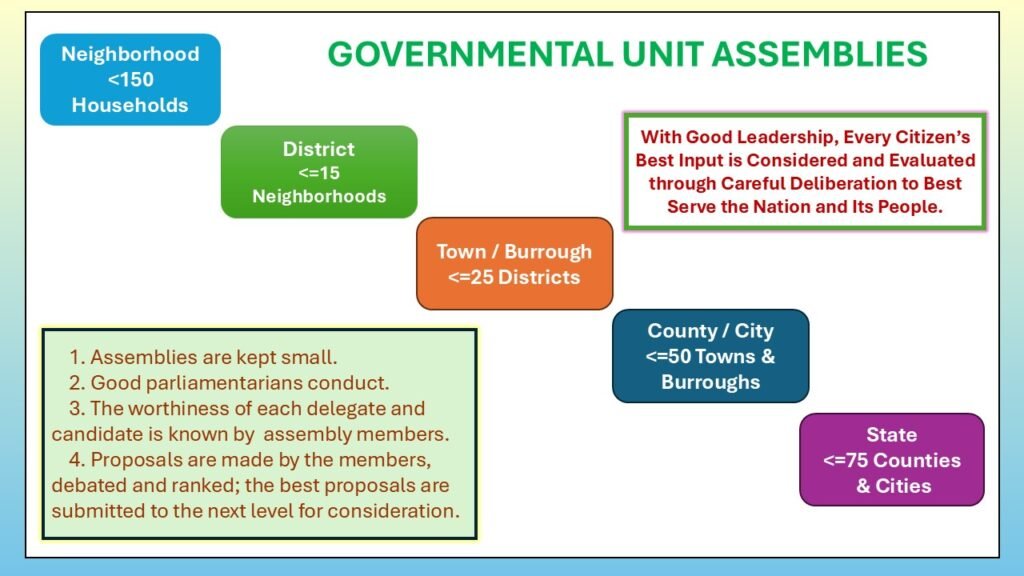
GOVERNMENTAL UNIT ASSEMBLIES
With Good Leadership, Every Citizen’s Best Input is Considered and Evaluated through Careful Deliberation to Best Serve the Nation and Its People.
1. Assemblies are kept small.
2. Good parliamentarians conduct.
3. The worthiness of each delegate and candidate is known by assembly members.
4. Proposals are made by the members, debated and ranked; the best proposals are submitted to the next level for consideration.